Rust & AI Weekly #2: a P2P 1.0, agents that out-benchmark Python, and Rust creeping onto the GPU
Welcome back to Rust & AI Weekly — the curated, vetted sweep of crates and tools showing up where Rust meets AI. Same deal as last week: no rubric, no thousand-word evaluations (that's the Crate Radar series' job), just the things worth a bookmark, each in a line or two, with a status line underneath so you're not bookmarking something that quietly died last summer. The theme this week wrote itself: the agent layer is consolidating fast — with newcomers now beating the Python frameworks on the benchmarks they care about — and Rust took two visible steps onto the GPU and into training, the side of the stack we'd all quietly conceded to Python. Plus the week's genuine flagship release. Let's dig in.
(Status lines reflect public signals as of June 2026 — stars and downloads are approximate and move fast.)
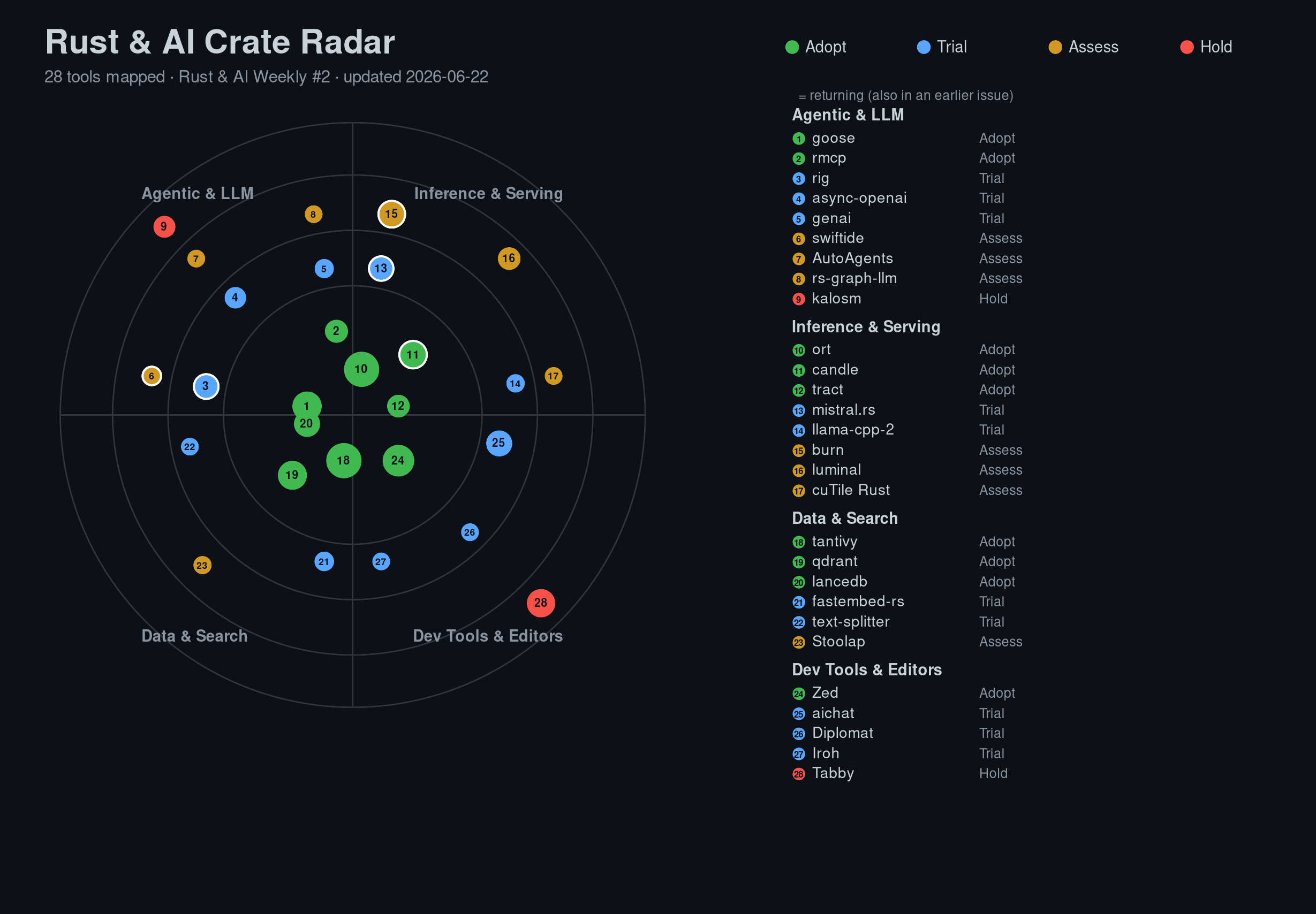
This week's radar — 28 tools and counting. The six new entries join it; explore the interactive version.
Pick of the week
Rig — The most-adopted Rust framework for building LLM apps and agents: providers, embeddings, vector stores, and tool-calling all behind a small set of composable traits. Conspicuously absent from issue #1 and overdue — if you're starting a serious agent project in Rust today, this is the default starting point, not a curiosity.
Maintenance: very actively maintained (0xPlaygrounds; breaking changes flagged as ongoing) · Latest: active releases through 2026 · Adoption: ~6.7k★; production users incl. Cloudflare, Neon, Nethermind, and St. Jude — the clear leader of the Rust agent-framework cluster
Agentic AI & LLM frameworks
AutoAgents — A multi-agent framework with type-safe agent models, structured tool-calling, configurable memory, and pluggable LLM backends, built to run on both server and edge. The headline is the benchmark: it (and Rig) stay under ~1.1 GB peak memory where every Python framework measured blew past 4.7 GB, and it reportedly beats LangGraph by ~43% on latency. Python bindings ship via autoagents-py.
Maintenance: actively developed (liquidos-ai) · Latest: active through 2026 · Adoption: emerging, benchmark-led; PyPI bindings — smaller community than Rig, but the numbers are real
rs-graph-llm — A graph-based framework for interactive multi-agent workflows with distributed execution — think LangGraph's mental model, Rust's runtime. The maintainer reports a logistics deployment running at 99.99% uptime, which is a more interesting adoption signal than a star count.
Maintenance: actively maintained (solo — note the bus-factor) · Latest: v1.4.2 · Adoption: smaller; one named production deployment (logistics) — promising, verify the fit before you bet a workflow engine on it
Inference, Models & Serving
candle — Hugging Face's minimalist ML framework: a PyTorch-shaped API with CUDA, Metal, and WASM backends, broad model support (LLaMA, Phi, Gemma, StarCoder, and friends), and the ability to run a model in the browser. The other glaring omission from issue #1 — if you want HF-blessed inference without the Python, start here.
Maintenance: actively maintained (Hugging Face) · Latest: candle-core 0.10.2 · Adoption: ~7.8k★; the de-facto Rust ML framework
mistral.rs — A fast, cross-platform inference engine that's quietly become the most feature-complete one in Rust: text, vision, audio, image-gen, and embeddings, plus a built-in agentic loop with web search, code/shell execution, and OpenAI-compatible skills. Rust crate and Python package both.
Maintenance: very actively maintained (EricLBuehler) · Latest: v0.8.2 (CUDA graphs, FlashInfer paged kernels, MoE opts; strong on GB10/B200/H100) · Adoption: heavy; the multimodal-plus-agentic option when llama.cpp bindings aren't enough
Burn — A next-generation tensor library and deep-learning framework that doesn't just infer — it trains, then deploys the same model across CUDA, ROCm, Metal, WebGPU, and Vulkan via its CubeCL compute layer. This is the entry that makes last week's closing question (below) live.
Maintenance: very actively maintained (Tracel AI) · Latest: v0.20 (Jan 2026; introduced CubeK kernels on CubeCL) · Adoption: the leading Rust-native training framework — the rare "train in Rust, not just serve" bet
cuTile Rust — Not a crate you adopt yet — a research result worth knowing about: memory-safe, data-race-free GPU kernels written in Rust, with B200 benchmarks. The interesting part isn't the speed, it's the safety model reaching the place GPU code has always been least safe.
Maintenance: research artifact (arXiv, June 2026) · Latest: paper + early code · Adoption: none yet — a watch-this-space signal, not a dependency
Data, Vectors & RAG
Swiftide — Fast, streaming indexing and query pipelines for RAG — parallel and async by design — that has grown agent and tool-calling support on top. From the team building bosun.ai's autonomous-code-improvement platform, so the RAG-over-codebases path is well-trodden.
Maintenance: actively maintained (bosun-ai) · Latest: active 2026 (pre-1.0 — expect breaking changes) · Adoption: growing; powers bosun.ai — promising, still early
text-splitter — The unglamorous RAG primitive: split text into semantic chunks up to a token or character budget, at sensible boundaries, callable from both Rust and Python. The crate you reach for to stop hand-rolling chunking and getting it subtly wrong.
Maintenance: actively maintained (benbrandt) · Latest: v0.30.x · Adoption: widely used across Rust RAG stacks; also shipped as the semantic-text-splitter Python package
Dev Tools & Interop
Diplomat — Generate idiomatic bindings (C, C++, JS, with more via a plugin interface) from explicitly-tagged "bridge" Rust, so refactoring your library can't silently change its FFI surface. The clean way to expose a Rust AI core to the rest of a polyglot org — and it's been proven in production carrying ICU4X to other languages.
Maintenance: actively maintained (rust-diplomat; ICU4X lineage) · Latest: active 2026 (Java/Panama backend in progress) · Adoption: battle-tested as ICU4X's cross-language layer — compare against UniFFI before you choose
Iroh 1.0 — The week's flagship release. Dial any device by its cryptographic public key, not its IP, over QUIC — IPs become ephemeral hints, the key is the stable identity, and a direct UDP hole-punch lands ~90% of the time. For anyone wiring up distributed or multi-agent systems that have to find each other across NATs, this is the connectivity substrate you were about to hand-roll. Official Python, Node, Swift, and Kotlin bindings.
Maintenance: very actively maintained (n0 / N0 Inc.) · Latest: v1.0 (Jun 2026) with a committed wire-protocol stability guarantee · Adoption: 200M+ endpoints created in the last 30 days; four years and 65 pre-releases to reach 1.0
A thought for the week
Last week I asked whether Rust-on-inference / Python-on-training is a permanent division of labor or just the current truce. This week handed over two data points pulling against the truce: Burn shipped a serious multi-backend training story, and cuTile showed memory-safe GPU kernels are a research reality, not a fantasy. Two swallows don't make a summer — Python's training ecosystem is a decade and a million tutorials deep — but it's the first week in a while where the "you'd never train in Rust" reflex felt less like a law and more like a habit. I still wouldn't rewrite your training pipeline. I'd just stop assuming you never will.
Before I go
The putt.day habit from last week survived contact with a full sprint — one hole of 3D mini-golf, par or bust, close the tab. Turns out the discipline of exactly one putt is the whole point; the day I let myself take a mulligan is the day it becomes a time sink. Anyway. Back to the crates.
That's the issue. Got a Rust+AI crate or tool I should feature next week? Reply and tell me — reader picks shape the list.
Keep shipping, Decebal