Rust & AI Weekly #5: the officials arrive
Welcome back to Rust & AI Weekly, the curated, vetted sweep of crates and tools showing up where Rust meets AI. Today's issue: BullMQ ships an official Rust port with benchmark receipts, xAI open-sources 845,000 lines of coding agent, and Tokio tries on a full-stack web framework. The theme this week is first-party Rust: three platform vendors shipped official Rust implementations inside eight days, and none of them were ports begged for by the community. The evaluation question is shifting from "is the community binding maintained" to "is the vendor's governance something you can live with", and this issue has one entry that makes the difference vivid.
(Status lines reflect public signals as of July 20, 2026; stars and downloads are approximate and move fast.)
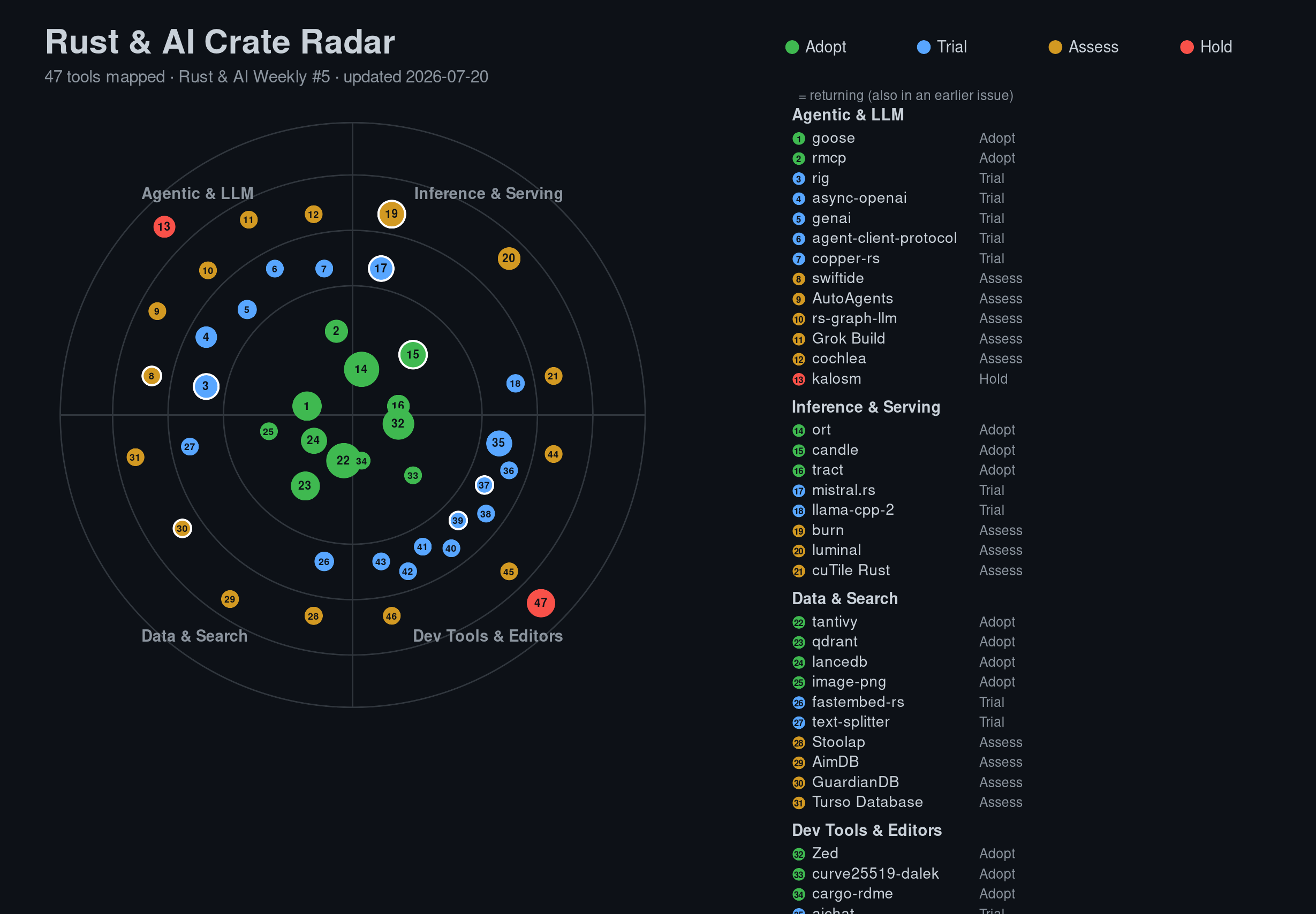
This week's radar: five new entries join the map, and GuardianDB logs a fourth consecutive mention. Explore the interactive version.
Pick of the week
BullMQ for Rust 1.1.0 — Manuel Astudillo's Taskforce.sh brought one of the most heavily deployed Redis-backed job queues to Rust as a first-party implementation, published as bullmq-official because the obvious crate names were squatted. The design decision that earns the pick: it executes the exact same Lua scripts as the Node, Python, PHP, and Elixir implementations, so the state transitions that lose jobs when done wrong (claiming, completing, retrying, stalling) arrive pre-hardened by years of production traffic, and a Rust worker can drain a queue your Node services fill today, no adapter, no migration. The announcement ships benchmarks against the Node reference on identical scenarios, slightly ahead on ingestion and level on processing, which is the honest shape for a week-one port. Three releases landed in the first four days, which reads as responsiveness rather than churn. Issue #4 gave apalis the Postgres seat at the job-queue table; this is the Redis seat, and it arrived with the vendor's name on it. Go deeper with the feature parity notes and the Rust guide, which state plainly what is intentionally missing (Redis Cluster, wait_until_finished, telemetry) so you can check your dealbreakers before the spike.
Maintenance: actively maintained (Taskforce.sh Inc., SOC 2 certified) · Latest: v1.1.0 (Jul 15) · Adoption: Trial; battle-tested core, week-old Rust surface, interop with existing BullMQ fleets from day one
Agents & coding
Grok Build — xAI open-sourced the Rust agent harness, TUI, and tool layer behind its grok coding CLI: roughly 845,000 lines under Apache 2.0, with Agent Client Protocol support, which means it plugs into the ACP registry this radar flagged in issue #3. The catch sits in the governance line, not the license line: the repo is synced from xAI's monorepo and external contributions are not accepted, and the release followed a privacy controversy, which is why a community fork (gork-build) already exists to strip vendor telemetry. Read it as the largest production Rust agent codebase you can study today; adopt it with your eyes on who steers it. Simon Willison's notes are a good short orientation.
Maintenance: maintained by xAI; open source, closed contribution model · Latest: open-sourced Jul 15 (Apache 2.0) · Adoption: Assess; a reference codebase first, a dependency second
cochlea 0.1.0 — a headless, deterministic audio engine built explicitly for AI agents: write a score as data, render it offline to byte-identical PCM, then let the agent "listen" through numbers (loudness, onsets, pitch, key) and assert what it heard via a verification DSL, so a failed assertion becomes a retry instead of a "does this sound right?" ping to a human. It ships an MCP server so an agent calls render, probe, and diff as tools, and cochlea probe runs on any WAV or FLAC with no score in sight, which is a well-designed adoption wedge. Nine crates, version 0.1.0, one maintainer: early by every rubric line, but this is the most thought-through agent-native API design the radar has seen in weeks.
Maintenance: brand new, solo maintainer · Latest: v0.1.0 (Jul 2026, 9 crates) · Adoption: Assess; the design deserves your attention even if your dependency tree waits
Frameworks & data
Topcoat — the Tokio team open-sourced a batteries-included full-stack web framework: async server components that query the database directly, and $() expressions that type-check as ordinary Rust, render on the server, and transpile to JavaScript for the browser, no wasm bundle, no client build step. It is explicitly early-stage, but stewardship is the whole story here: the org that runs the async runtime under nearly every Rust service just took a position on how Rust web apps should be built. The Hacker News thread has the sharpest early critiques alongside the enthusiasm.
Maintenance: actively developed (tokio-rs) · Latest: announced Jul 2026, early-stage · Adoption: Assess; too young to bet on, too well-stewarded to ignore
Turso Database — Rust Bytes led this morning with the headline: Turso's SQLite rewrite in Rust is out of beta, and the team announced a from-scratch Postgres frontend on the same core. Here is the verdict to go with the story. The architecture bet (one Rust core, pluggable SQL frontends compiling to VDBE bytecode, positioning itself as the LLVM of databases) is credible because the boring parts are unusually well done: 260+ contributors, deterministic simulation testing, fuzzing, formal methods. But hold the two claims apart: the SQLite frontend is a shipping product; the Postgres frontend is an ambition with a pgmicro proof of concept and a Doom demo. Adopt the discipline, assess the database, and do not migrate anything you love to the Postgres layer this quarter.
Maintenance: very actively maintained (Turso, 260+ contributors) · Latest: SQLite rewrite out of beta; Postgres frontend announced (Jul 2026) · Adoption: Assess; the testing culture is Adopt-grade, the compatibility surface is not yet
Language watch
- Rust 1.97.1 — point release out this week, fixing an LLVM miscompilation that had been lurking since 1.87. If you pin toolchains in CI, this is the bump you make without a meeting.
- RFC 3955: named
Fntrait parameters — approved this week; a small but real step for API expressiveness in closure-heavy code. - RFC 3983:
bf16primitive type — newly opened this week. Watch this one if you touch inference at all: bfloat16 is the dtype half the ML world standardized on, and a primitive would let candle, burn, and friends drop conversion shims. - Polonius on nightly — the compiler MCP to enable
-Zpolonius=nexton nightly entered final comment period this week, alongside one enabling the next-generation trait solver by default on nightly. Two long-gestating borrow-checker and solver rewrites are both knocking on the door at once.
In brief
dashu — TWiR's Crate of the Week: a pure-Rust arbitrary precision numbers family, self-suggested by its author JacobZ · ripgrep 15.2.0 — Andrew Gallant is back after a brutal fight with encephalitis and shipped a release the same week; welcome back, BurntSushi · kache 0.10.0 — the build cache the radar upgraded to Trial in issue #3 adds instant download dedup, no more polling; verdict holds · Danube 0.15.1 — the Rust messaging platform lands native Apache Iceberg export, streaming straight to the lakehouse · prost-protovalidate 0.6 — zs-dima's protovalidate for prost hits full conformance (2872 of 2872) with compile-time codegen plus runtime CEL · Guardian Sentinel — GuardianDB's fourth consecutive mention: a terminal UI for operating nodes of the P2P database; the tooling keeps arriving, the Assess verdict keeps holding · Battery packs — Niko Matsakis published community-curated crate sets, templates, and recipes for common Rust domains; aimed squarely at crate discovery fatigue.
Elsewhere
- Microsoft shipped its Agent Framework for Go in public preview, written up by Quim Muntal, and The New Stack pointedly noted that Anthropic and OpenAI still ship no first-party Go SDKs. The Rust mirror of that complaint: there are no official Anthropic or OpenAI Rust SDKs either, and the seats are held by community crates this radar already tracks (rig, genai, async-openai). On the week the officials arrived everywhere else, the model vendors are the holdouts.
- Go-land shipped Fyne 2.8, the GUI toolkit's biggest release in years. The Rust seats at that table filled up the same week: Freya 0.4 landed a major rewrite that drops Dioxus for a custom reactive model and typed builders, and Slint holds its Trial verdict from issue #3. Cross-platform native GUI is quietly becoming a race Rust is in, not chasing.
- OpenTelemetry's compile-time instrumentation for Go went stable, by Kemal Akkoyun: telemetry injected at build time, no hand-written spans, no eBPF agent. Rust has no answer at that table;
tracingis excellent and entirely manual. That gap is a real project idea, and the radar will note who picks it up.
A thought for the week
Three vendors shipped first-party Rust inside eight days: a job-queue company, an AI lab, and the team behind the async runtime itself. For years the Rust story in a leadership meeting was "the community binding is good, we think"; the new story is "the vendor ships Rust, now read the governance". Those are different risks. A community crate with a solo maintainer is a bus-factor problem you can see. An official repo that accepts no contributions, like Grok Build, is a steering problem you cannot fix with a PR. When the official option arrives, do not skip the diligence out of relief; move the diligence one line down, from the license to the contribution model.
Before I go
The strangest artifact in this week's sweep: Elara Mesh, a post-quantum provenance protocol whose maintainer of record is an AI agent operating under a signed, revocable, on-chain mandate, publishing its own receipts. The mesh is one operator's machines and the honest docs say so, which is itself refreshing. Whether agent accountability infrastructure proves useful or stays a curiosity, somebody is now running the experiment in public rather than proposing it.
One more note: the BullMQ pick sets up a natural Deep Dive, Redis versus Postgres job queues in Rust, bullmq-official against apalis, with exit costs measured on both. If that would earn a read, reply and say so.
That's the issue. Got a Rust+AI crate or tool I should feature next week? Reply and tell me; reader picks shape the list.
Keep shipping, Decebal