Rust & AI Weekly #19: decide which archive you accept

An illustrative sorting gate for archive policy. Original 3D artwork; neither a system diagram nor measured evidence.
Astral announced tar-codec on October 27. Its parser interprets an archive as one supported tar family and rejects combinations that mix incompatible conventions. That matters when one component inspects an archive and another extracts it. Their agreement about the members is part of the interface you depend on.
For a service that accepts uploaded archives, I would start with its accepted-format policy and a small corpus of real inputs. Run the proposed parser against that corpus before changing extraction code. Include rejected files in the results, with a reason.
The announcement says uv 0.13 uses tar-codec by default. The crate README still warns that it is early and not ready for production use. A particular consumer's integration gives you a case to inspect; it does not settle compatibility or operational risk for your own application.
This edition also covers CGA's panic analysis and apalis 1.0's worker migration. The checks below are proposed acceptance plans. I have not run the tools, reproduced their examples or independently measured performance for this review.
Sources checked November 2, 2026. Scan window: October 26–November 2. Older package releases are dated explicitly. Three evaluations this week; the remaining candidates did not earn enough verified detail for another recommendation.
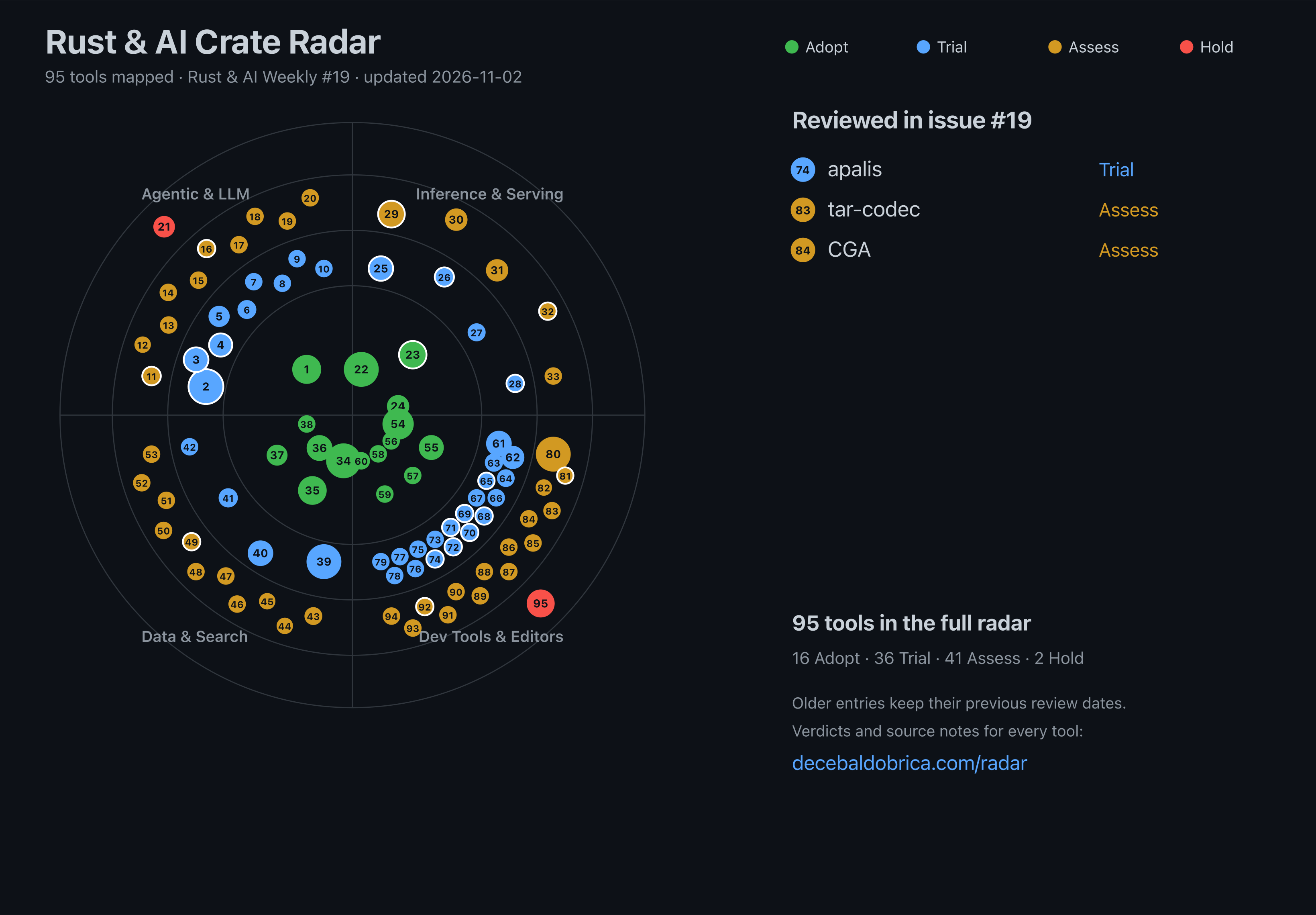
Two additions, with apalis retaining Trial. The snapshot carries issue 18 forward and contains 95 tools: 16 Adopt, 36 Trial, 41 Assess and 2 Hold. Explore the radar.
tar-codec: assess the formats your application needs
Assess. The README's readiness warning warrants a compatibility trial before a production migration. The registry version record identifies 0.0.15, uploaded October 13. The October 27 announcement is newer than the package release. Its ownership and visible development sit with Astral's astral-codec repository; the checked main revision is dated October 30. Those are maintenance signals, separate from the README's readiness warning.
Tar's extensions make a useful filename listing harder to define than it first appears. The announcement explains how GNU extensions and POSIX pax metadata can supply information around ordinary file records. A parser has to decide which records belong together and which values take precedence. If a scanner and extractor interpret that framing differently, inspecting the scanner's output alone does not verify what extraction will do.
tar-codec addresses that ambiguity by classifying the archive from its first block into its supported POSIX or GNU interpretation. It rejects mixed conventions. The design also constrains GNU long-name and long-link records rather than accepting arbitrary sequences of overrides. That is a deliberate compatibility choice; a file another tar implementation tolerates may be rejected here.
Parsing and extraction need separate checks
The repository separates physical and logical tar framing from extraction. Its README exposes archive parsing policy and a separate extraction policy. Filesystem operations have another set of concerns, including where entries can be written. Decoding a name consistently and allowing that name to become a path are different operations to review.
For an upload service, I would write down the intended behaviour for these input classes:
- Ordinary files and directories produced by the archive tools customers already use.
- GNU long names and POSIX pax metadata, each within its own supported family.
- Deliberately mixed-family input that the proposed parser should reject.
- Links and paths that exercise the application's extraction restrictions.
Record the expected member names before extraction, the resulting filesystem entries afterwards, and the errors for rejected inputs. Keep the corpus independent of the parser implementation. A test that derives its expected names from the same decoder only confirms that decoder agrees with itself.
The scope also matters for build systems. Astral discusses Python source distributions, whose build steps can execute code. Changing an archive parser does not remove that execution model. If an agent can request dependency installation, the package selection, execution permissions and build environment still need their own controls. This review makes no claim that tar-codec makes arbitrary package installation safe.
What would change the verdict?
I would consider a contained trial after the accepted corpus passes, rejected cases have useful diagnostics, and the application has an explicit extraction policy. Existing permissive inputs need a decision: preserve compatibility through a reviewed path, reject them with a documented error, or defer the migration. Quietly falling back to another parser deserves scrutiny because it can reintroduce the interpretation differences being tested.
The README lists unsupported formats and encoding goals. It does not promise to be a universal replacement for every historical tar variant. Review those limits against actual stored archives before selecting it for a restore path. A newly uploaded package and a backup created years ago are different compatibility obligations.
- Release: 0.0.15, October 13; not a prerelease-tagged registry version.
- Maintenance: Astral-owned repository with an October 30 main revision checked.
- Adoption: uv 0.13 integration reported by Astral, not independently exercised here.
- Licence: MIT OR Apache-2.0 in package metadata; the MIT file permits commercial use subject to retaining its notice. The checked package does not declare a Rust minimum version.
I have omitted the announcement's speed comparison. No benchmark was reproduced, and this review does not establish a workload, hardware and baseline combination that would support transferring that result to another service.
CGA: useful panic paths, with a compiler attached
Assess. Compiler-specific analysis and profile-dependent findings need validation beside an existing build. Tweede golf's October 27 Call Graph Analyzer article shows why searching for unwrap gives an incomplete picture of panic behaviour. Calls through dependencies, implicit checks and generated paths can contribute. CGA examines monomorphized MIR through a rustc driver and can report paths from entry points to panic functions.
This is a source-tool evaluation. The checked manifest says version 0.1.0 and publish = false. That string is not evidence of a crates.io release. The source checkout uses compiler internals; its toolchain file pins nightly-2026-10-18 with rustc development components. Plan for a compiler-specific analysis environment.
A report is a review input
The README and article explain that compiler options affect the graph. A panic path can remain in MIR and disappear later in LLVM. Inlining changes the shape of diagnostics too. The author recommends a dedicated analysis profile using opt-level=2, while describing false positives with size-oriented settings.
That advice creates a practical comparison to manage. If production uses another profile, retain both sets of settings in the review record. Do not label the analysis output as the exact deployed binary's call graph. A clean report under one compiler and profile is bounded by that configuration and the analyser's own correctness.
I would begin with one executable whose input handling already has a clear panic policy. Add a deliberately reachable panic as a control, run cargo cga check, then inspect the path it reports. Remove the control and review the remaining findings against actual input conditions. A report with no findings is useful only after the positive control shows the analysis lane works.
For a reported path, check whether the relevant input can reach it in this program. If a bounds check is unreachable by construction, record the invariant and the code that maintains it. If the invariant depends on a caller, make that dependency visible in the interface or test. Suppressing the diagnostic without preserving the reason makes later refactoring harder to assess.
Blacklists have a narrower job than isolation
CGA can also flag paths to configured blacklisted functions. The article demonstrates process-related checks but explicitly warns that external object files and assembly are outside that coverage. Such a blacklist can support a code review rule. It cannot enforce a sandbox for code generated by an agent or supplied by a dependency.
The author also describes fragile areas around unstable MIR, vtables, coroutine paths and build tooling that expects ordinary rustc. Those limits are why I would assess it beside an existing build rather than immediately make it a release blocker. First establish that the project's build scripts and standard-library build work in the analysis environment, and that failures leave actionable evidence.
- Release: source manifest 0.1.0, unpublished; checked revision dated October 20.
- Maintenance: public OpenDevicePartnership repository and a detailed October 27 author walkthrough.
- Adoption: no independent deployment verified in this review.
- Licence: MIT, allowing commercial use with the required notice.
- Toolchain: pinned nightly and rustc-private integration, not a stable-only library dependency.
I have not executed that assessment, so there is no measured false-positive rate or claim of panic freedom here.
apalis 1.0: retain Trial, test the worker lifecycle
Trial retained. One worker and backend can be tested against application recovery requirements before wider adoption. Rust Bytes brought apalis back into this week's reading. The 1.0.0 release was published October 12, and the main crate reached the registry that day. This is a revisit of an older stable release, replacing the radar's release-candidate description rather than presenting it as a new November launch.
apalis provides background workers and middleware for jobs, with backend integrations developed in separate crates. For an inference or agent service, that can be useful when a request creates work that must outlive the HTTP connection. The choice still depends on the backend's persistence and recovery behaviour. An in-memory example does not establish those properties for a deployed queue.
Compile the migration before judging the upgrade
The tagged changelog describes breaking changes including service_fn becoming taskfn, WorkerContext::id becoming name, and a monitor registration factory receiving a run count. Backend configuration and polling interfaces also changed. Existing workers need a migration check; a final version number does not make older examples source-compatible.
One documentation limit deserves care: the changelog's summaries give inconsistent descriptions of the new Task generic parameters. I would resolve that against the exact backend and tagged API before writing a migration recipe. This edition deliberately gives no copy-and-paste generic signature. Keep the main crate and backend versions explicit in the trial record rather than assuming they move together.
The workspace declares Rust 1.85, but the main package manifest does not inherit that rust-version field and registry metadata leaves it empty. I would test the chosen compiler with the complete locked dependency graph before claiming a supported minimum. The workspace declaration alone is insufficient evidence for a published-package MSRV guarantee.
Retry behaviour belongs in the application test
For one existing job type, I would test a failure after its external side effect but before successful completion is recorded. Inspect both the queue and the external system after retry. Decide how a repeated task identifies work already performed. Retry middleware and queue deduplication do not, by themselves, establish exactly-once effects in an unrelated service.
Then stop a worker while it holds a task, restart it, and inspect how that backend handles unfinished work. Test an idle worker's shutdown too. The release notes include work on waking idle workers during monitor shutdown, which gives a specific behaviour to exercise rather than a reason to skip lifecycle checks.
Keep the first trial bounded to a job you can observe and recover manually. Capture task identity, attempts, completion state and shutdown outcome in logs. If the job calls an inference endpoint, include the endpoint's request identifier where available so repeated application work can be distinguished from a repeated queue delivery. Those are proposed observability requirements, not a claim about fields apalis automatically provides.
- Release: stable 1.0.0, October 12.
- Maintenance: apalis-dev repository, tagged changelog and component documentation checked.
- Adoption: backend support and examples are project documentation, not an independently verified production reference.
- Licence: package metadata offers MIT OR Apache-2.0; the tagged root MIT file permits commercial use with notice retention.
No queue or worker was run for this review.
Language and project notes
The October 27 variadic generics survey results describe use cases for a hypothetical feature. Tuple trait implementations and macro workarounds recur in the responses. Treat the examples as design discussion, not syntax available in a stable compiler. The post also notes possible over-representation of Bevy users, which limits conclusions about all Rust users.
For a library maintaining tuple implementations, a useful action now is to retain a small example of the API friction and its current workaround. That gives language discussions something concrete to evaluate. It does not justify delaying a working implementation on the assumption that a particular design or stabilization date has been agreed.
The Rust project's October 26 funding guide separates ongoing maintenance, project goals and individual contributors. An organisation budgeting for Rust work can use that distinction to choose where support goes. General support for infrastructure and funding a specific implementation have different decision paths.
The Foundation's October 29 staffing update names David Wood as interim support for its technical activities and announces planned recruitment for a Director of Technical Services. That is an organisational update, with future recruitment distinguished from a completed hire. It does not change any tool verdict in this issue.
Reading list
- Astral's tar-codec design: read the framing and extraction sections before evaluating compatibility.
- CGA's author walkthrough: keep the caveats about MIR and build options beside the examples.
- This Week in Rust 675: discovery links and project activity. A merged change in its list is not automatically a shipped stable feature.
- Rust Bytes: another discovery source; dates in this edition come from primary package and release records.
- Go Weekly 622: a cross-ecosystem reading route, including discussion of custom analysers in
go test. That item is presented as a proposal, not a shipped capability; it is not a recommendation to add an unreviewed analyser to CI.
For the archive review, write down one accepted file and its expected members before running the compatibility check. Which archive would you put first in that corpus?